Raja Porus: The Legendary King of Jhelum Who Challenged Alexander the Great
In the heart of Punjab, where the mighty river Jhelum flows through the fertile plains, once stood a kingdom ruled by one of history’s most courageous warriors, Raja Porus. This brave king’s defiant stand against Alexander the Great in 326 BCE not only shaped the course of ancient history but also established the land of Jhelum as the place where the world’s greatest conqueror met his match. The echoes of this epic confrontation still resonate through the hills and valleys of our beloved district, making Jhelum a place of immense historical significance.
The story of Raja Porus and the Battle of Hydaspes represents more than just a military encounter; it embodies the spirit of resistance, honor, and dignity that has always characterized the people of this region. Today, visitors can witness this glorious heritage at the monument near Chotala, a testament to the enduring friendship between Greece and Pakistan, and a reminder of the day when two great civilizations clashed on the banks of the Jhelum River.
The Mighty Kingdom of Raja Porus
Raja Porus, known in Sanskrit as Puru or Paurava, ruled over a vast kingdom that encompassed much of present-day Punjab, with the Jhelum River forming the eastern boundary of his domain. His kingdom, called Paurava, was one of the most prosperous and well-organized states in the Indian subcontinent during the 4th century BCE. The fertile lands watered by the Jhelum River supported a thriving agricultural economy, while the strategic location made it a crucial crossroads for trade between Central Asia and the Indian plains.
Historical accounts describe Porus as a man of exceptional physical stature and moral character. Ancient Greek historians, including Arrian and Plutarch, wrote extensively about his impressive height, which was said to be well over six feet – remarkable for that era. More importantly, they praised his courage, dignity, and the respect he commanded among his subjects. His army was well-disciplined and included fierce warriors, swift cavalry, and the formidable war elephants that would prove to be a significant challenge for Alexander’s forces.
The kingdom’s capital was strategically located near present-day Jhelum city, taking advantage of the river’s natural defense and the fertile alluvial plains that supported large populations. Archaeological evidence suggests that the region was densely populated and economically vibrant, with sophisticated urban planning and advanced metallurgical skills that produced superior weapons and tools.
Alexander’s Eastern Campaign and the March to Jhelum
By 327 BCE, Alexander III of Macedon had already conquered vast territories stretching from Greece to the Indus Valley. His relentless eastern campaign had subdued the Persian Empire and brought him to the northwestern frontiers of the Indian subcontinent. After crossing the Indus River and receiving submission from various local rulers, Alexander learned about the powerful kingdom of Porus beyond the Jhelum River.
Unlike many other rulers who had submitted to Alexander without resistance, Porus made it clear that he would defend his homeland. When Alexander sent envoys demanding submission, Porus reportedly replied with characteristic boldness that he would meet Alexander at the border of his kingdom – but with arms in hand, not as a supplicant. This defiant response set the stage for one of the most significant battles in ancient history.
The monsoon season of 326 BCE had swollen the Jhelum River, making it a formidable natural barrier. Porus positioned his army on the eastern bank, confident that the flooded river would prevent Alexander from crossing. His strategic positioning demonstrated his military acumen and deep understanding of the local terrain – an advantage that local commanders have always enjoyed in this region.
The Epic Battle of Hydaspes
The Battle of Hydaspes, fought in May 326 BCE, stands as one of the most tactically brilliant encounters in military history. For several weeks, the two armies faced each other across the swollen Jhelum River, with Alexander seeking a way to cross while Porus vigilantly guarded every possible ford and crossing point.
Alexander’s solution was characteristically audacious. Under cover of darkness and monsoon storms, he led a select force upstream to a crossing point near modern-day Chotala. Meanwhile, his general Craterus remained at the main camp with strict orders to cross only after the battle had begun, creating a diversion that kept Porus uncertain about the main attack’s direction.
When dawn broke on that fateful day, Porus found himself facing Alexander’s advance guard on his own side of the river. Despite being caught off-guard, the brave king quickly reorganised his forces and prepared for battle. His army, numbering around 30,000 infantry, 4,000 cavalry, and 200 war elephants, took position on the plains near the river bank.
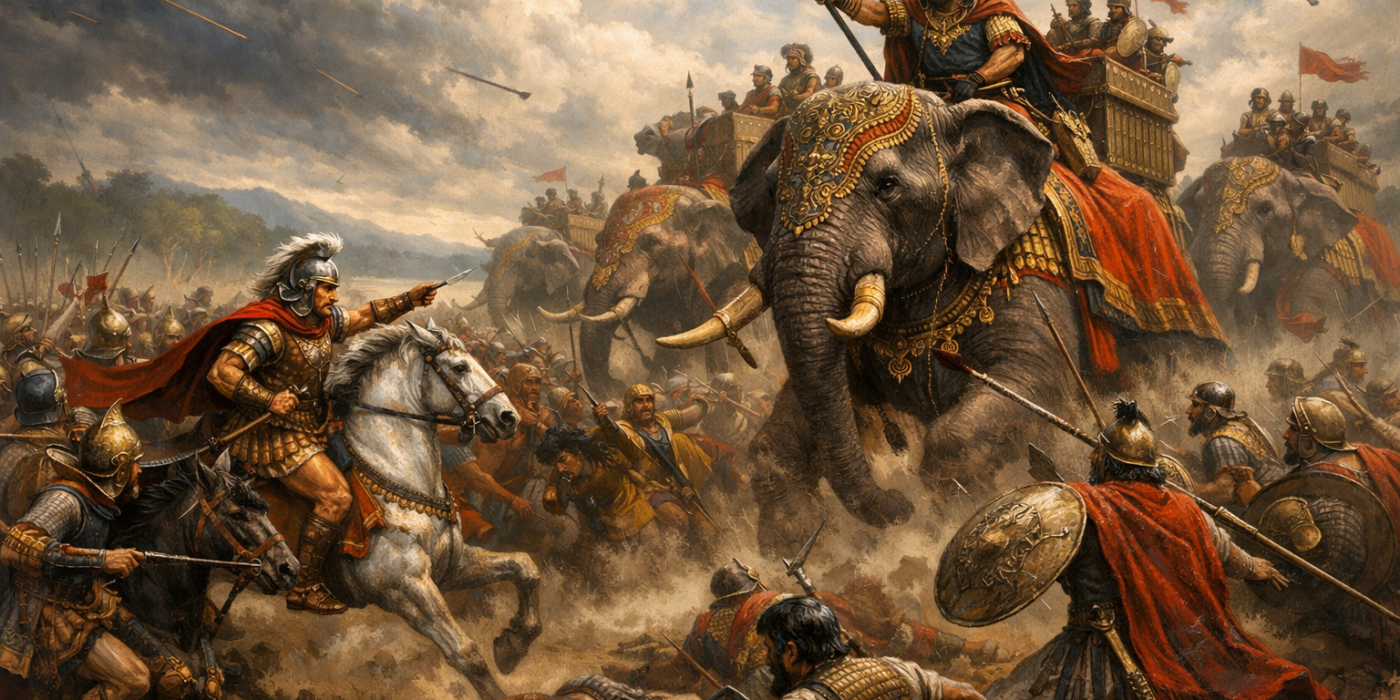
The battle that followed was fierce and prolonged. Porus placed his war elephants in the front line, creating a formidable barrier that initially caused significant casualties among Alexander’s cavalry. The sight of these massive beasts, with armed warriors on their backs, was terrifying for the Macedonian horses, many of which had never encountered elephants in battle.
However, Alexander’s tactical genius and his army’s superior discipline gradually turned the tide. Using coordinated attacks and exploiting gaps in the Indian formation, the Macedonians managed to isolate and neutralize the war elephants. The battle raged for hours, with both sides displaying extraordinary courage and skill.
The Famous Exchange Between Two Kings
The most memorable moment of this historic encounter came not during the heat of battle, but in its aftermath. Despite his valiant effort, Porus was eventually defeated and captured. Wounded and bleeding, he was brought before Alexander the Great. What happened next has become one of history’s most celebrated examples of mutual respect between adversaries.
When Alexander asked Porus how he wished to be treated, the defeated king replied with words that have echoed through the centuries: “Treat me as a king should treat another king.” This dignified response so impressed Alexander that he not only restored Porus to his throne but also extended his kingdom’s boundaries as a reward for his courage and honor.
Alexander is said to have remarked that he had never encountered such bravery and dignity in defeat. The mutual respect between these two great leaders transcended the animosity of war and established a friendship that would influence Alexander’s subsequent decisions in India. This exchange exemplifies the noble traditions of warfare and honor that have always been valued in the subcontinent.
Alexander’s Last Campaign and the Decision to Return
The Battle of Jhelum proved to be Alexander’s last major military engagement and marked the beginning of the end of his eastern conquests. Although victorious, his army had suffered significant casualties, and the fierce resistance encountered from Porus and his warriors had a profound psychological impact on the Macedonian troops.
After the battle, Alexander continued eastward, crossing the Chenab and Ravi rivers. However, when his army reached the banks of the Beas River, they had finally reached their limit. The soldiers, exhausted by years of continuous campaigning and daunted by reports of even more powerful kingdoms beyond the Ganges, refused to march further. They had heard tales of the Nanda Empire’s vast armies and were no longer willing to face such challenges so far from home.
Reluctantly, Alexander agreed to turn back. The decision to retreat from the banks of the Beas River meant that the Battle of Jhelum was effectively Alexander’s final conquest. The courage shown by Porus and his warriors had demonstrated that India would not be easily conquered, contributing to the war-weariness that ultimately ended Alexander’s eastern campaign.
The Monument near Chotala: A Symbol of Eternal Friendship
Today, visitors to District Jhelum can witness a beautiful testament to this historic encounter at the monument located near Chotala, in Tehsil Pind Dadan Khan. This impressive structure, funded by the Government of Greece, stands as a symbol of the enduring friendship between Greece and Pakistan and commemorates one of history’s most significant battles.
The monument is strategically located near the actual site where Alexander crossed the Jhelum River, making it not just a memorial but a place where history truly comes alive. The structure incorporates both Greek and local architectural elements, reflecting the cultural exchange that began with that ancient encounter between two great civilizations.
The Greek government’s decision to fund this monument demonstrates the lasting impact of the Battle of Hydaspes on Greek consciousness. It acknowledges not just Alexander’s military prowess but also pays tribute to the courage and honor of Raja Porus, whose dignity in defeat earned the respect of his conqueror and has continued to inspire people for over two millennia.
Visitors to the monument can explore detailed displays that explain the battle’s progression, the strategies employed by both sides, and the geographical factors that influenced the conflict. The site offers panoramic views of the Jhelum River and the surrounding plains where this epic encounter took place, allowing visitors to truly appreciate the strategic challenges faced by both armies.
Legacy and Historical Significance
The legacy of Raja Porus extends far beyond the battlefield. His story has become an integral part of the cultural heritage of Punjab and particularly of Jhelum district. Local folklore, poetry, and oral traditions have preserved and embellished his tale, making him a symbol of resistance against foreign invasion and a paragon of royal dignity.
The battle also marked a crucial turning point in the history of the region. While Alexander’s victory was tactical, Porus’s moral triumph and the respect he earned helped preserve the dignity of the local population. The friendship between the two kings also ensured that the region was not subjected to the harsh treatment often meted out to conquered territories.
For students of military history, the Battle of Hydaspes remains a masterpiece of tactical innovation. Alexander’s river crossing under adverse conditions and his coordination of multiple forces across difficult terrain continue to be studied in military academies worldwide. Similarly, Porus’s use of war elephants and his defensive positioning demonstrate sophisticated understanding of local conditions and innovative military thinking.
Modern-Day Jhelum and the Porus Heritage
Today’s Jhelum district takes great pride in its connection to this glorious chapter of history. The region continues to embody the same courage and resilience that characterized Raja Porus and his people. Local schools and colleges regularly organize visits to the monument, ensuring that new generations understand and appreciate their remarkable heritage.
The story of Raja Porus has also become an important part of Pakistan’s national narrative, representing the country’s long tradition of resistance against foreign aggression while maintaining honor and dignity even in the face of superior military force. His example continues to inspire people across the region and beyond.
The monument near Chotala has become an important tourist destination, attracting history enthusiasts from around the world. It serves as a bridge between ancient and modern times, connecting visitors with one of history’s most dramatic encounters while showcasing the natural beauty and strategic importance of the Jhelum region.
Raja Porus stands as an eternal symbol of courage, honor, and dignified resistance. His confrontation with Alexander the Great on the banks of the Jhelum River represents a defining moment not just in local history, but in the broader story of human civilization. The monument at Chotala, generously funded by Greece, ensures that this remarkable tale of two great kings will continue to inspire future generations.
As we walk through the streets of modern Jhelum or stand on the banks of the ancient river that gave our district its name, we carry with us the legacy of a king who chose to fight rather than surrender, who faced defeat with dignity, and who earned the respect of his conqueror through his noble character. The story of Raja Porus reminds us that true victory lies not always in military triumph, but in maintaining one’s honor and principles, even in the darkest hours. This timeless lesson continues to resonate through the ages, making Jhelum not just a district in Punjab, but a place where history, honor, and heroism converge in eternal memory.